
For press & industry
Media Kit
Information about A Whiff of Herbal Murder in one place: the book blurb, a short biography and sample interview questions. For press images or any additional material, please get in touch.
The book
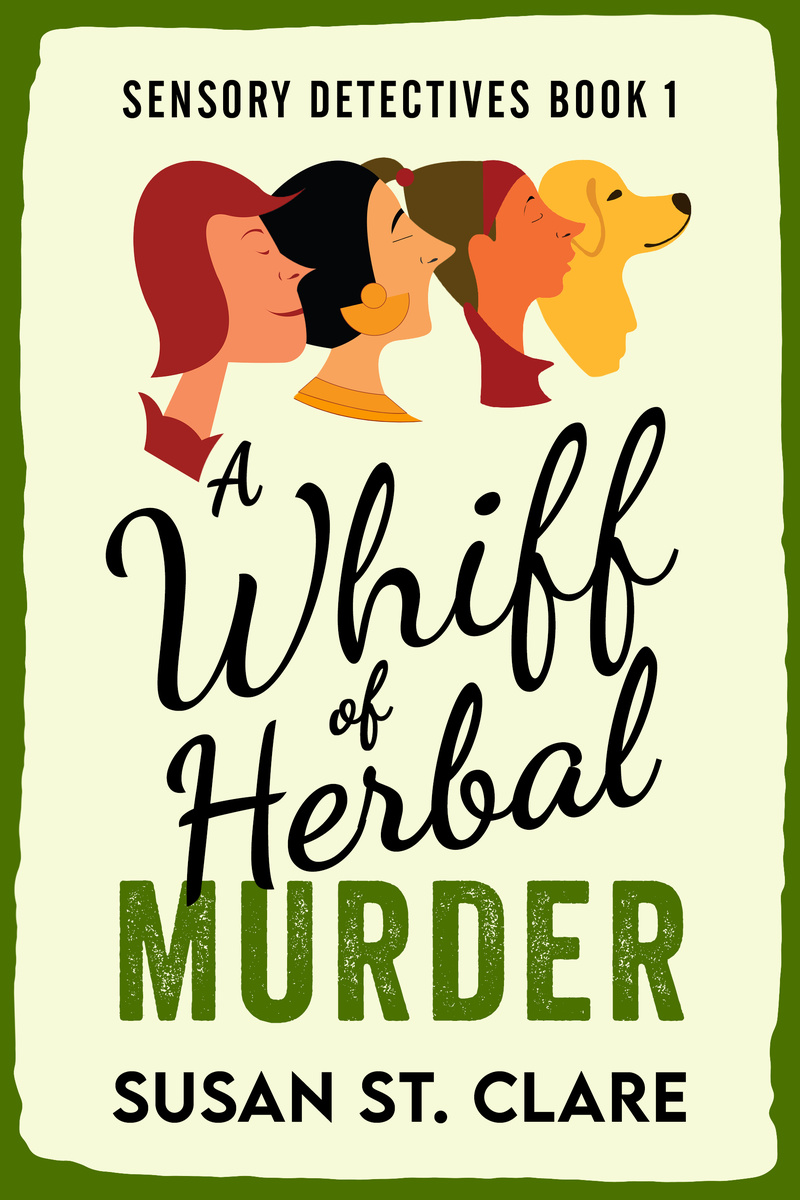
A Whiff of Herbal Murder
Cosy Mystery
When her latest romance flops, Sophie Grammar must recover her lost writing mojo. Quickly. And if she doesn’t escape the incessant whirring of her neighbour’s oversized power drill, her mind will unravel faster than her plot threads. Her sensory disorder magnifies noise, and if she can’t work, she’ll lose her home: her one sanctuary from the outside world.
Her eccentric tea leaf-reading (and amdram director) Aunt Edwina invites her to Norfolk for a break. Sophie doesn’t like change – her condition makes her crave control – but Watermill Cottage could be the perfect retreat. Except when she arrives, Sophie finds Edwina lying injured outside the old mill’s rehearsal space. A fall? No, Edwina insists: a push.
With Edwina in hospital, Sophie steps in as temporary director for the Watermill Players and sets out to discover who attacked her aunt. The local police consider it a storm in a teacup. No crime. Just an accident.
But when one of the Players is poisoned during her own death scene, it’s clear a murderer is in their midst. With the police floundering, Sophie teams up with Edwina, artist Nyla and Juno, Edwina’s dog, to scent out the killer.
Between Sophie’s acute sensory detection, Edwina’s teacup insights, Nyla’s insider medical knowledge (as the GP’s wife), and Juno’s nose, the Sensory Detectives soon leave the police trailing. But another murder is brewing, and it’s a race against time to bag the killer before they strike again …
- Publisher
- Next Chapter
- Publication date
- 2026-10-06

Short bio
Susan St Clare
Susan St Clare is the pen name of an academic and thriller author who wanted a brighter space to explore her love for cosy mysteries and romance. She writes heartwarming mysteries filled with quirky characters and village charm, sweet romances in glorious seaside settings, and Regency romances with a dash of spice and a hint of humour. When she isn’t weaving tales of love and intrigue as Susan St Clare, she can be found diving into classic literature and exploring academic histories – 16th and 19th centuries being her particular favourites. She is a member of the Romantic Novelists’ Association (RNA) and the Society of Authors (SOA). Susan lives in the UK, where she loves spending time with her family, walking in the countryside, baking using her mum’s old recipes and directing plays! Connect with Susan and discover her latest releases at susanstclare.co.uk.
Sample interview questions
Answers to the questions I am asked most often, ready to quote or to use as a starting point for your own.
What inspired you to write a cosy mystery? And this book in particular?
I’ve always enjoyed solving mysteries and puzzles. My thriller, So Now Go Tell, has a mystery element, and I relished the detail and depth of plotting needed to make that work. But I also love creating quirky characters in village settings, and indulging my appetite for light humour. Put all those ingredients together, and a cosy mystery series seemed the perfect choice for me as a writer. Add an interest in sensory (and extra sensory) perception, and you have my own unique recipe.
In A Whiff of Herbal Murder, my three protagonists use all the usual methods open to amateur sleuths: questioning suspects, gathering intel and piecing together clues. But when every avenue leads to a dead end, sleuth Sophie Grammar begins following a literal scent: a sensory trail left by the murderer. And the hypersensitivity she’s always cursed becomes the sharpest tool in the team’s investigative armoury.
Was there a specific moment when the idea clicked?
Absolutely. I was having lunch with some friends at a watermill café, and saw a poster there advertising a ‘clairvoyant evening.’ I’d been mulling over an idea for a cosy mystery set among a group of amdram actors (theatre being another of my hobbies!), and featuring a tea-leaf reader. But in the setting of the old mill, with that poster staring me in the face, the story started taking on a life of its own.
How much of your personal experience shaped the story?
Edwina – Sophie’s tealeaf-reading aunt – is a combination of two women I’ve known in my life. One was a relation; the other a family friend and tasseographer, whose predictions were so often uncannily accurate. Edwina’s percipience, tactile warmth, wisdom and sheer zest for life were inspired by these two wonderful characters. Some of Sophie’s experiences are drawn from my own, and the story’s Norfolk setting is a tribute to the happy times I’ve spent there, visiting family.
What does your daily writing routine look like?
In the summertime, I’m normally up between 5 and 6 am and at my desk (our dining table!) soon after. I love the quiet of those first two or three hours, and the early morning light on our beautiful garden. Almost every tree and shrub there holds a memory of buying and planting. My mind is at its clearest then, though getting up is harder as the days shorten. Sometimes I’ll work all day; on others, family life calls and I treasure those times. When I’m deep into a book or an edit, I’ll move heaven and earth to keep going – and sometimes forget to eat if my husband isn’t around!
Do you outline first, or discover the story as you write?
I always hatch ideas and plot in my head first. Everything I do, including directing a play, starts that way. Then I plan on paper, using a new notebook for each novel. The story morphs as I write, but I do need a structure to guide me or I’ll zoom off to explore some fascinating side path and end up with 150,000 words instead of 80,000! For me, planning never stilts the story; it simply helps me to keep focussed.
What was the strangest thing you had to research online for this book?
Poisons and their effects. I’d studied herbal poisons while directing Romeo and Juliet, but needed to be sure of a few gory details, such as how quickly the poison would work; the exact symptoms the victim would experience; and – crucially! – how much of it would be needed to kill a normally healthy person. I read some detailed reports on accidental poisonings from Digitalis (Fox Gloves) which I accessed online. They were necessary to my research, but uncomfortable questions to type into a search engine!
Did any character surprise you by changing from your original plan?
Yes – Brian, the Watermill Players’ lighting technician. He was one of those characters who just morphed on the page as I watched him. I would never have planned a ballet-loving builder with a passion for theatre, but he was such fun to create! It’s a joy when that happens, I think.
Which of the three leads was the hardest to write?
Nyla, my third sleuth. I’d started off by making her an illustrator, but didn’t see her as having any particular extra sensory skill. Her role in the sleuthing team was to provide useful medical intel, since she is married to the local GP and helps out on the surgery reception desk. She therefore gets to hear quite a lot of gossip. But by the end of the book, I decided to give her a special skill of her own. During my studies, I’d read about colour/mood perception: people who sense mood through an aura of colour. It seems the perfect choice for Nyla’s artistic background, and something I will develop in future books.
What central theme or message is at the heart of this book?
That being different needs no excuse – and as Sophie finds, it can be a gift, rather than a curse. That message is also endorsed by Edwina and Brian.
What was the most oddly specific piece of village history you researched for the book?
The village name. I wanted something that reflected Norfolk’s history, and gave a sense of my setting’s small community. I’d already come up with the idea of the Watermill Players performing a rehashed Viking version of Hamlet. And as many place names in the region have Viking roots, it all fitted together well. So I searched for the Viking words for wheel (hjól) and village (býr), and Holberry Down was born.
Press enquiries
For interviews, review copies, features and events, please send a message and I will come back to you as quickly as I can.